

Patient handling. Highest MSD rates. Clinical staff under pressure.
Healthcare workers have the highest MSD rates of any sector. Patient transfers, sustained awkward postures, and repetitive clinical tasks create compound risk — at the same time as staff shortages make prevention critical.

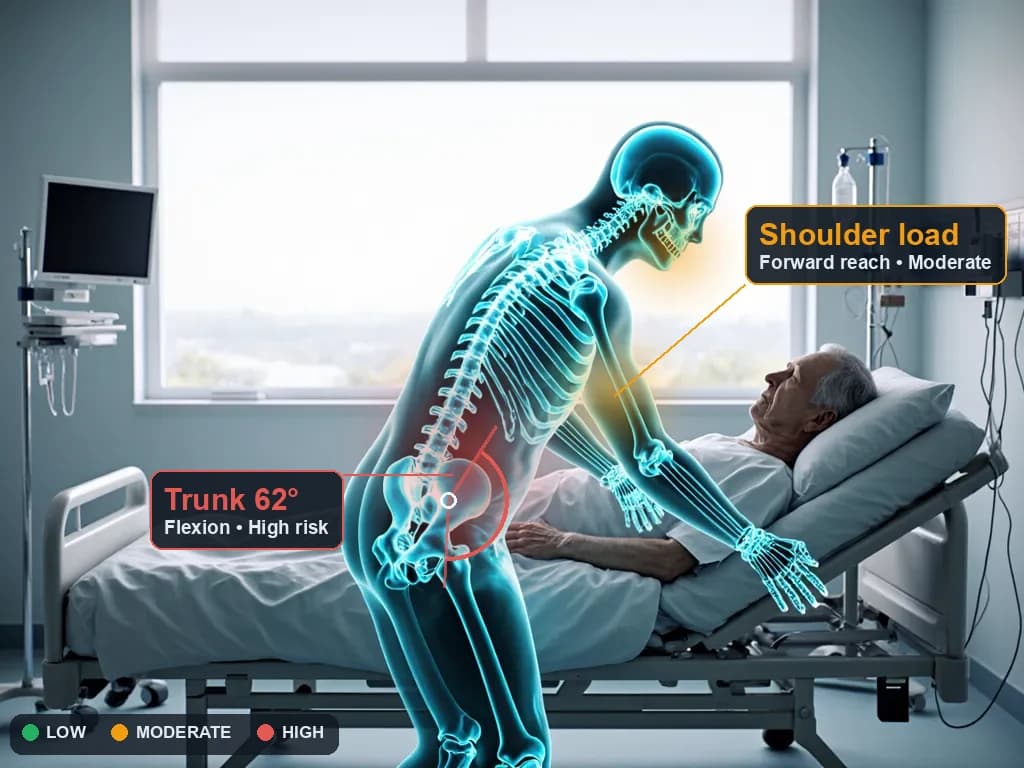
Healthcare covers hospitals, clinics and care settings — where clinical staff combine patient handling with sustained procedural postures and repetitive tasks.
Nurses and technicians transfer and reposition patients (high, asymmetric, unpredictable loads), hold awkward postures during procedures and theatre, and repeat clinical tasks — drawing blood, setting IVs, charting — shift after shift.
Healthcare has the highest MSD rate of any sector, and ergonomic risk affects both staff and patient safety — at the same time as staff shortages make prevention and retention critical.
The teams that answer for ergonomic risk here
One assessment, the evidence each role is on the hook for in healthcare.
OSH / EHS
Patient handling gives healthcare the highest MSD rate of any sector — the manual-handling hazard you most have to control.
What you ownHR
Nursing and clinical staff can't be pulled off the ward, and privacy rules out cameras in many areas.
What you ownAudit & Compliance
NABH and ISO 45001 expect documented patient-handling risk assessment.
What you ownKey ergonomic risks for Healthcare
Each risk is addressed by a validated assessment method — scored by AI, validated by an ergonomist.
Patient handling — transferring, repositioning
Patient transfers involve high-force, asymmetric, and often unpredictable whole-body postures. REBA assesses trunk, neck, arm, and leg load during transfer tasks.
Sustained postures — clinical procedures, theatre
Surgical and clinical procedures involve sustained awkward postures for extended periods. RULA scores upper-limb load during precision work; REBA covers whole-body clinical postures.
Repetitive tasks — injections, IV, documentation
Repetitive procedural tasks — drawing blood, setting IVs, entering records — create upper limb cumulative exposure. OCRA and JSI both quantify this risk at task level.
Manual force — equipment handling, pushing trolleys
Handling medical equipment, pushing trolleys, and transferring supplies create manual handling loads. NIOSH calculates the safe weight limit for each handling task.
Privacy-first by default.
Clinical areas restrict cameras for patient privacy. Text-survey assessment keeps coverage at 100% without a lens in the ward, while permitted areas can still use phone capture.
What we'd run for Healthcare — and what it takes
A clear division of responsibility. You bring the access; we bring the engine, the methods and the clinical sign-off.
What you bring
- The wards and patient-handling tasks in scope.
- A coordinator to share the assessment link — staff self-capture in ~5 minutes, around shifts.
- Your ward camera and patient-consent policy — we match capture to it.
What we bring
- NIOSH, REBA and JSI plus the NMQ discomfort survey for patient-handling and posture.
- A certified ergonomist who reviews and signs off every result before any worker sees it.
- NABH and ISO 45001-ready risk documentation, plus an aggregate risk dashboard.
Regulatory requirements for Healthcare
These are legal obligations — not guidelines. Ergocure generates the documentation each mandate requires.
How Ergocure.ai helps
Ergocure assesses patient-handling and clinical tasks privacy-first — text in clinical areas, camera where permitted — scoring REBA, NIOSH and RULA to document the highest-MSD-rate workforce against OSH Code and health-and-safety obligations.
Problem → solution
The scenario
A 600-bed multi-specialty hospital where ward nurses and technicians perform repeated manual patient transfers alongside long clinical-documentation sessions on shared workstations.
The compliance trigger
A cluster of nurse lower-back injury claims and an NABH re-accreditation review flag manual patient-handling as an uncontrolled staff-safety risk with no documented assessment.
How Ergocure.ai helps
Privacy-first text assessment in the wards (no camera) plus phone capture in permitted areas score REBA and RULA, targeting transfer-aid deployment and technique correction for the highest-risk roles.
~30% fewer manual-handling injury reports over 12 months
Documented staff-safety evidence for NABH and ESIC across the highest-MSD-rate workforce
Illustrative scenario based on typical sector conditions — not a specific Ergocure client outcome.
Ergonomics is risk mitigation with a measurable return.
Published occupational-safety & ergonomics ROI benchmarks · See the full business case →
Built for Healthcare — not adapted to it.
Healthcare is the one sector where ergonomic risk directly affects both staff and patient safety. Ergocure applies REBA and RULA for clinical posture assessment and OCRA for repetitive procedural tasks. Clinical-grade output — because the people using the platform are clinicians themselves.