

Screen-intensive work. High absenteeism. BRSR disclosure mandated.
IT workers average 8–10 hours of screen time daily. RULA and ROSA risk factors accumulate invisibly — until absence, claims, and BRSR audit gaps make them visible.
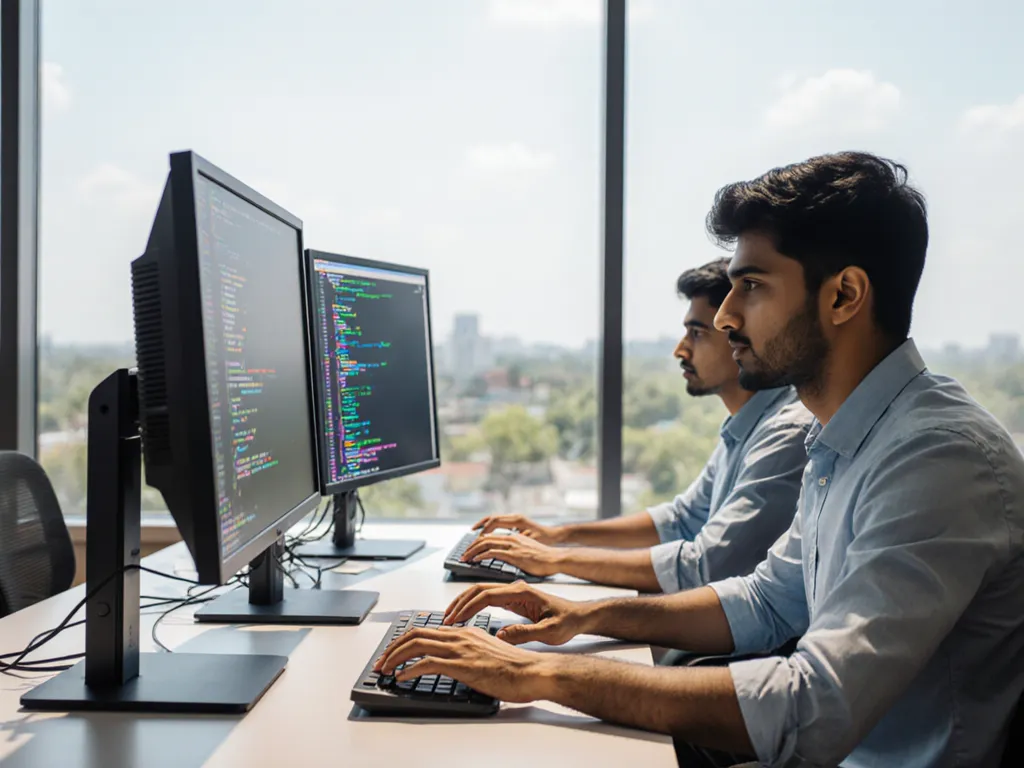
IT, ITES and contact centers are India's screen-desk core — software, BPO/KPO, support and high-volume voice/chat operations across offices and home setups.
Workers average 8–10 hours of screen time daily, often across rotating shifts; contact-center roles add headset use and relentless keyboard/mouse repetition; WFH permanently widened the spread of workstation quality.
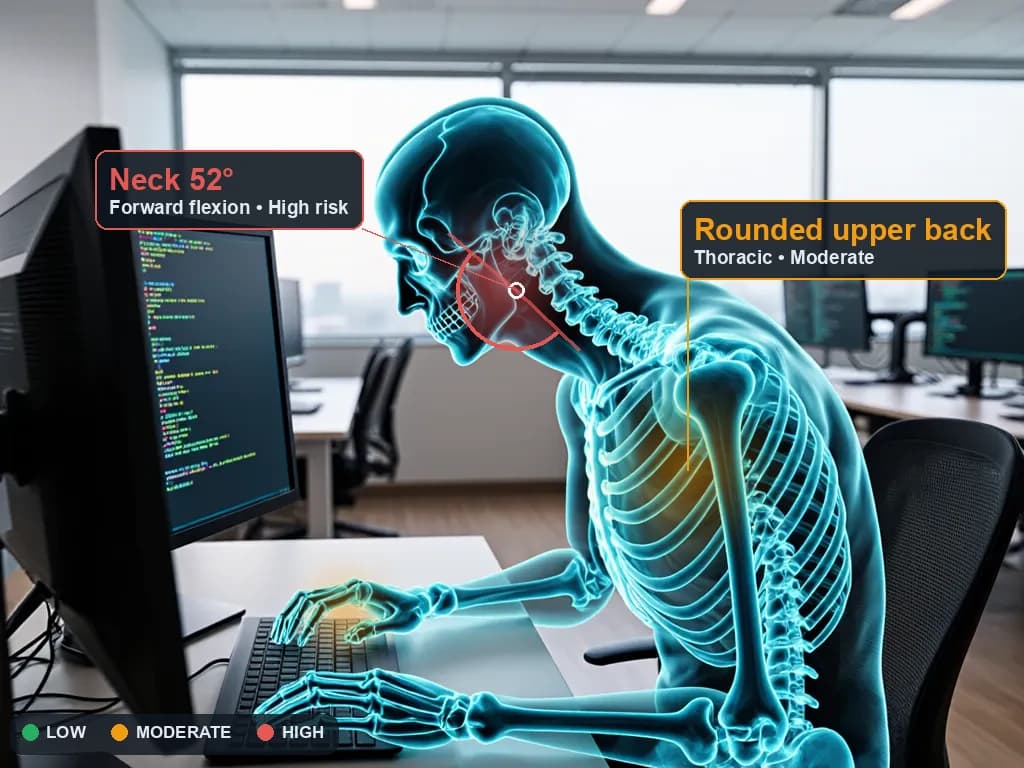
It's the highest-density MSD-risk population in the country. Risk accumulates invisibly until it surfaces as absence, claims and BRSR audit gaps — and 100% coverage is only economical with software.
The teams that answer for ergonomic risk here
One assessment, the evidence each role is on the hook for in it / ites / contact centers.
HR
Thousands of screen users across office and WFH need covering — with no clinic visits and no one off the floor.
What you ownOSH / EHS
Repetitive keyboard-and-mouse work and static screen posture drive the MSD and absenteeism numbers you answer for.
What you ownAudit & Compliance
Client security and ISO 45001 audits ask for documented DSE assessment of your delivery floors.
What you ownKey ergonomic risks for IT / ITES / Contact Centers
Each risk is addressed by a validated assessment method — scored by AI, validated by an ergonomist.
Upper limb strain — repetitive keyboard/mouse
High-frequency keyboard and mouse use drives elbow, wrist, and shoulder disorders. RULA screens posture; OCRA quantifies repetitive action frequency and force.
Neck/shoulder — sustained forward posture
Forward head posture during screen work is the leading source of neck and shoulder pain in IT workers. RULA scores neck flexion and shoulder load together.
Workstation setup — WFH vs. office variation
WFH permanently worsened average workstation quality. ROSA evaluates home setups with the same rigour as corporate offices — chair, monitor, keyboard, mouse.
Sedentary load — low movement, high hours
Extended static posture without postural variation loads the spine and reduces circulation. REBA's whole-body assessment captures the sedentary risk profile.
Camera in the office, text for WFH.
In-office desks use a 10-second phone capture; hybrid and remote staff complete a structured survey instead. Both score against the same frameworks, so WFH never becomes a coverage gap.
What we'd run for IT / ITES / Contact Centers — and what it takes
A clear division of responsibility. You bring the access; we bring the engine, the methods and the clinical sign-off.
What you bring
- Your office and work-from-home headcount in scope.
- A coordinator to push the assessment link to remote and hybrid staff — self-capture in ~5 minutes.
- Your device and data-privacy policy — we match capture to it.
What we bring
- RULA, ROSA and OCRA — camera in the office, camera-free for WFH and hybrid staff.
- A certified ergonomist who reviews and signs off every result before any worker sees it.
- DSE-compliant records across every screen user, plus an aggregate risk dashboard.
Regulatory requirements for IT / ITES / Contact Centers
These are legal obligations — not guidelines. Ergocure generates the documentation each mandate requires.
How Ergocure.ai helps
Ergocure assesses 100% of screen workers — office and WFH — via camera or text, turning invisible RULA, ROSA and OCRA risk into an auditable BRSR Principle 3 record before it surfaces as absence or claims.
Problem → solution
The scenario
A 6,000-seat IT services and BPO provider runs 24×7 contact-centre and software-delivery shifts, with roughly 40% of staff now hybrid or fully remote.
The compliance trigger
A global client's ISO 45001 vendor due-diligence audit demands documented ergonomic hazard controls across all delivery staff — including WFH — and the firm has no coverage for remote workers.
How Ergocure.ai helps
Phone capture in the office and a structured text survey for hybrid and remote staff bring 100% of screen workers under the same RULA, ROSA and OCRA scoring, closing the WFH coverage gap.
100% screen-worker coverage including WFH — client audit passed
~22% fewer MSD-related sick days over a year, BRSR Principle 3 fields auto-populated
Illustrative scenario based on typical sector conditions — not a specific Ergocure client outcome.
Ergonomics is risk mitigation with a measurable return.
Published occupational-safety & ergonomics ROI benchmarks · See the full business case →
Built for IT / ITES / Contact Centers — not adapted to it.
India's 20M+ IT desk workers are the highest-density MSD risk population. WFH permanently worsened workstation quality. BRSR mandates disclosure. Ergocure delivers ROSA + RULA assessments at a price point that makes systematic assessment economically viable for the first time.