

Six risk factors. One configurable engine.
Every ergonomic hazard falls into six families. Each is assessed by validated methods — scored by AI from a phone capture, or camera-free from a structured survey, and signed off by a certified ergonomist. This is the full library; methods light up as each is productised.
Compare the 11 live frameworks
Each validated method scores a different kind of ergonomic load. What each one measures, the body region it covers, its score range, and when to reach for it.
| Method | What it scores | Body region | Score range | Best for |
|---|---|---|---|---|
| REBA Rapid Entire Body Assessment | Whole-body posture + load | Neck, trunk, legs, arms | REBA score 1–15 | Varied, dynamic tasks — patient handling, assembly |
| RULA Rapid Upper Limb Assessment | Upper-limb posture | Neck, trunk, arms, wrists | RULA grand score 1–7 | Seated, screen-intensive desk work |
| ROSA Rapid Office Strain Assessment | Office workstation fit | Chair, monitor, keyboard, mouse, phone | ROSA grand score 1–10 (score > 5 = high risk) | Office / DSE screen workstations |
| NIOSH NIOSH Lifting Equation (Revised, 1994) | Manual lifting limit (Lifting Index) | Whole-body lift mechanics | Lifting Index (LI = Load ÷ RWL); RWL baseline 23 kg | Two-handed manual lifting tasks |
| OCRA Occupational Repetitive Actions (Checklist) | Repetitive upper-limb exposure | Shoulders, elbows, wrists, hands | OCRA Checklist Index (OCLI) | Repetitive cyclic tasks across a shift |
| JSI Job Strain Index | Hand / wrist exertion intensity | Hand, wrist, forearm | Strain Index (SI) — continuous | Wrist-intensive, forceful repetitive tasks |
| OWAS Ovako Working Posture Analysis System | Whole-shift working posture | Back, arms, legs + load | Action Category 1–4 per posture code | Industrial postures sampled across a shift |
| LUBA Loading on the Upper Body Assessment | Joint-load posture severity (LUBA) | Neck, trunk, shoulder, elbow, wrist | Composite Index → 4 action categories | Sustained awkward postures where joint-angle severity matters |
| MMC-ISO Manual Material Handling (ISO 11228-1) | Manual lifting limit — ISO 11228-1 | Whole-body lift mechanics | Lifting Index (LI) / simplified Annex tables | ISO-aligned manual lifting assessment |
| Liberty Mutual Manual Handling Tables (Snook) | Manual-handling acceptability (Snook) | Lift, lower, push, pull, carry | Population acceptability (% of workers) | Population-based push / pull / carry limits |
| RPA Rapid Posture Assessment | Rapid posture screen (EPR) | Whole-body static posture | EPR index 0–10 → 5 action levels | Fast first-pass posture screening |
 REBA
REBA  RULA
RULA  ROSA
ROSA  NIOSH
NIOSH  OCRA
OCRA  JSI
JSI  OWAS
OWAS  LUBA
LUBA  MMC-ISO
  Liberty Mutual
  RPA
RPA All scores are computed automatically from a phone capture (or a camera-free survey) and validated by a certified ergonomist before any worker sees them.
The six risk factors, and the methods that score them
Every ergonomic hazard falls into one of six families. Each is assessed by one or more validated methods — live now, or on the roadmap as the library is productised.
| Risk factor | What it covers | Assessed by |
|---|---|---|
| Postures | How the body is held while working — sitting, standing, bending, twisting, reaching. | RULAROSAREBAOWASLUBARPA+2 on roadmap |
| Loads | Manual handling of weight — lifting, lowering, carrying. | NIOSHLiberty MutualMMC-ISO |
| Forces | Effort exerted — gripping, pushing, pulling, sustained tension. | JSIREBA (force)+1 on roadmap |
| Repetition | How often the same movement is repeated — cycle times and task frequency. | OCRAJSI |
| Environment | The physical conditions around the work — lighting, noise, temperature, vibration, air. | CVS-Q+5 on roadmap |
| Global & Psychosocial | Whole-job factors — workload, stress, autonomy, shift patterns, and reported discomfort. | NASA-TLXWOSNMQ+4 on roadmap |
Postures
How the body is held while working — sitting, standing, bending, twisting, reaching.
Driven by: Poorly set-up workstations, sustained static positions, and tasks that force awkward joint angles.
Leads to: Neck, shoulder, back and wrist musculoskeletal disorders (MSDs) — the leading driver of desk-work discomfort and presenteeism.
What we measure
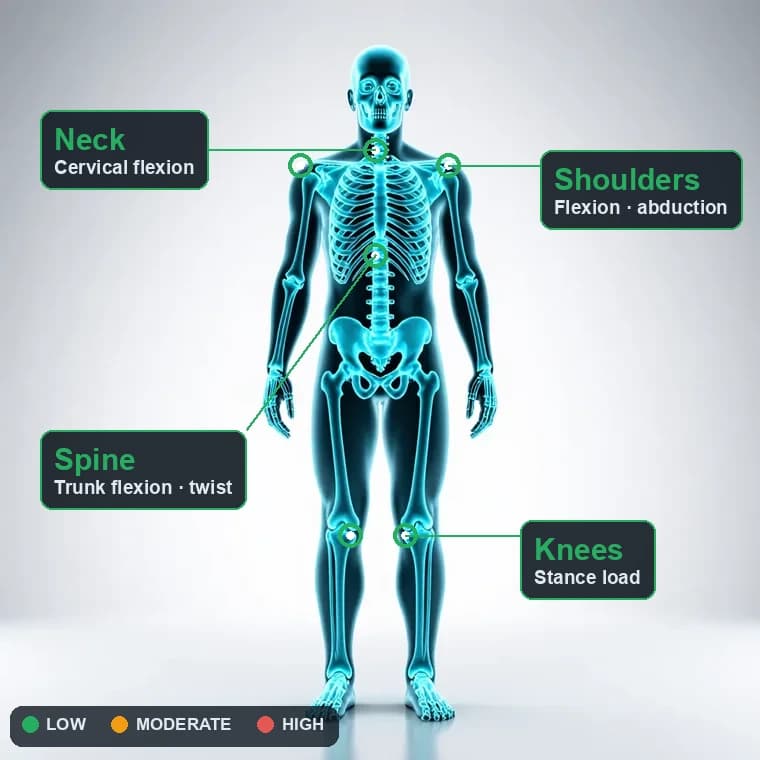
- Anatomical-neutral deviation: Exact joint angles measured against clinical thresholds to flag high-risk positioning.
- Static-position tracking: Duration of uncorrected fixed postures that restrict blood flow and stiffen muscle.
- Multi-axial spinal twisting: Simultaneous bending and twisting that compromises spinal-disc integrity.
Scores neck, trunk, arm and wrist posture for upper-limb strain at the desk or bench.
Rates the whole office workstation as a system — chair, monitor, keyboard, mouse, phone.
Whole-body posture score for varied, unpredictable tasks like patient handling and assembly.
Classifies back, arm and leg postures across a full shift to map industrial posture load.
Whole-body assembly screen combining posture, force and manual handling into one score.
Estimates cumulative load on the upper body from sustained joint angles.
Fast first-pass whole-body posture screen (EPR) to triage where deeper assessment is needed.
ISO limits for how long a static posture can be safely held.
Loads
Manual handling of weight — lifting, lowering, carrying.
Driven by: Heavy or awkwardly-placed loads, high lifting frequency, and poor lifting geometry.
Leads to: Lumbar (lower-back) injury — the single costliest manual-handling claim.
What we measure
- Weight-threshold mapping: Object weight benchmarked against safe guidelines to prevent overexertion.
- Asymmetrical-distribution analysis: Load handled away from the core, increasing spinal shear stress.
- Vertical & horizontal travel: Distance a load is lifted or carried, driving fatigue on major joints.
The gold-standard lifting check — computes a safe weight limit and lifting index for a task.
Population limits for pushing, pulling and carrying loads.
ISO-aligned manual lifting limit — the RNLE method with the ISO 11228-1 load constant.
Forces
Effort exerted — gripping, pushing, pulling, sustained tension.
Driven by: High grip force, heavy tools, and forceful exertions during tool and equipment use.
Leads to: Tendon and soft-tissue disorders in the hand, wrist and forearm.
What we measure
- Grip & pinch-pressure tracking: Localised force in the hands and fingers during tool or material handling.
- Push-pull resistance modelling: Forces required to start or sustain movement of carts, machinery, or assets.
- Sustained-muscle-tension logs: Periods of continuous isometric contraction that accelerate fatigue.
Scores hand/wrist-intensive tasks on intensity, posture, speed and duration of exertion.
REBA's force/coupling adjustment captures grip and load during whole-body tasks.
Estimates joint forces and torque for high-load tasks.
Repetition
How often the same movement is repeated — cycle times and task frequency.
Driven by: Short-cycle repetitive work — assembly, typing, scanning, packing — with too little recovery.
Leads to: Cumulative-trauma disorders such as tendinitis and carpal tunnel syndrome.
What we measure
- Cycle-time frequency: Duration of repeated sequences, flagging ultra-short, high-frequency actions.
- Tissue-recovery allocation: Ratio of active exertion to structured rest within each movement cycle.
- Cumulative daily motions: Total repetitive movements aggregated across the full shift.
Environment
The physical conditions around the work — lighting, noise, temperature, vibration, air.
Driven by: Poor lighting and glare, excess noise, thermal discomfort, and tool/vehicle vibration.
Leads to: Eye strain, fatigue, hearing risk, and hand-arm or whole-body vibration disorders.
What we measure
- Thermal-stress audits: Heat or cold levels and their effect on muscular flexibility and dexterity.
- Vibration-exposure logs: Hand-arm or whole-body vibration from tools and machinery.
- Visual ergonomics & glare: Lighting, contrast, and reflections that trigger posture adjustments or eye strain.
Screens for digital eye strain — dryness, blur and visual fatigue from screen work.
Predicts thermal comfort/discomfort from temperature, humidity, airflow and clothing.
Measures whole-body vibration exposure from vehicles and platforms.
Measures hand-arm vibration from power tools.
Evaluates the work environment and organisation, including mental load.
A practical checklist across workstation, environment and tools.
Global & Psychosocial
Whole-job factors — workload, stress, autonomy, shift patterns, and reported discomfort.
Driven by: Excessive pace and overtime, low control, weak support, and unmanaged fatigue.
Leads to: Stress, burnout, and the early-warning discomfort that precedes a reportable MSD.
What we measure
- Cognitive-workload indexing: Mental fatigue and frustration during complex or high-pressure intervals.
- Shift-pattern sustainability: Impact of irregular hours and rapid rotations on natural recovery cycles.
- Discomfort-symptom mapping: Anonymous self-reported strain matched to objective floor risks.
Evaluates work pace, mental load and organisation alongside the environment.
Self-report of mental workload across six dimensions.
Self-report of work pace, organisation and demand factors that drive strain.
Surveys psychosocial risk — demands, influence, support, stress.
Measures job demand, control and support.
Maps where workers feel musculoskeletal discomfort — the standard discomfort survey.
A detailed body-map discomfort survey.
Relief that shows up fast
Real outcomes employees reported after their assessment — anonymised.
I started getting relief from pain by day one.
Her advice has helped me manage my chronic back pain and perform better at work.
The footrest she suggested helped my chronic tailbone and back pain to a great extent.
Not sure which methods apply to you?
Tell us your industry and region — we'll map the risk factors, the methods, and the compliance that applies.