

Manual handling. Repetitive tasks. OSH Code enforcement is live.
Manufacturing workers face the broadest range of ergonomic risk factors — lifting, repetition, whole-body posture, and environmental exposures. OSH Code 2020 is in force with inspection and penalty teeth.

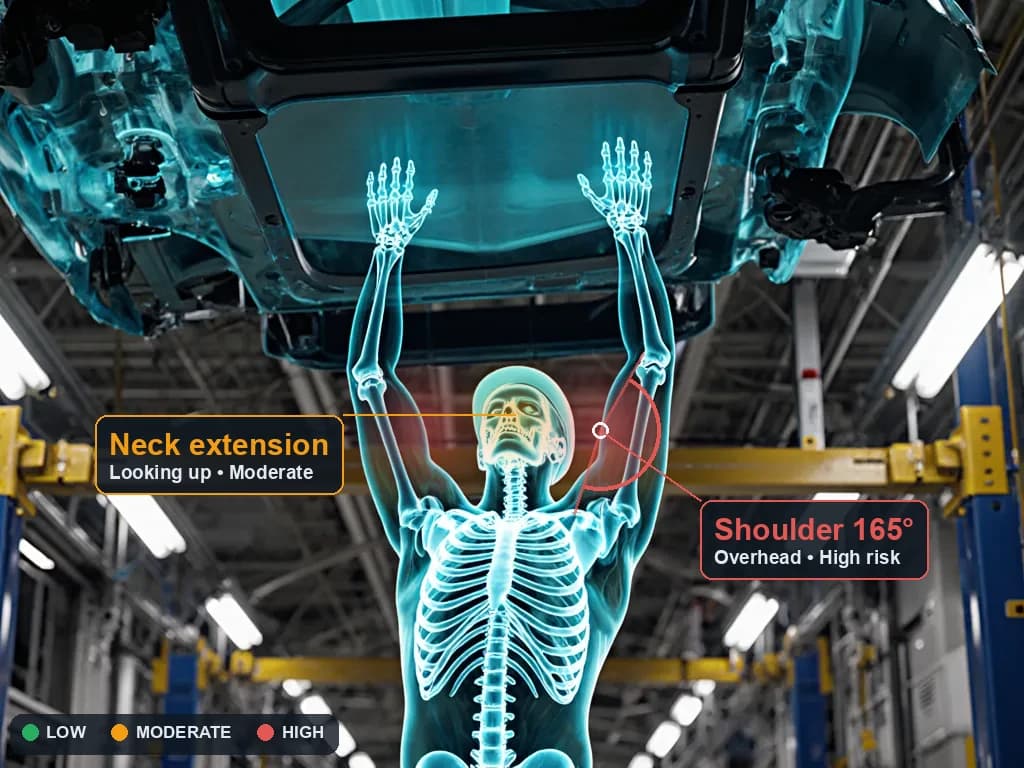
Manufacturing spans assembly, machining, packing, warehousing and material handling — the broadest range of physical ergonomic exposures of any sector.
Workers lift, carry, push and pull loads, run short repetitive cycles, exert grip force on tools, and hold awkward whole-body postures across long shifts — frequently with vibration and environmental stressors layered on.
OSH Code 2020 enforcement is most active here: hazard documentation, ergonomic risk assessment and corrective-action plans are now legal obligations, and a single back injury can sideline a skilled operator for weeks.
The teams that answer for ergonomic risk here
One assessment, the evidence each role is on the hook for in manufacturing.
OSH / EHS
Manual lifting, repetition and awkward whole-body posture are your top MSD hazards — and your HIRA must show a control for each.
What you ownAudit & Compliance
OSH Code 2020 inspections and ISO 45001 audits want task-level lifting evidence (NIOSH / ISO 11228-1) on file.
What you ownHR
Multi-shift and contractor workforces are hard to assess — none can leave the line for a clinic visit.
What you ownKey ergonomic risks for Manufacturing
Each risk is addressed by a validated assessment method — scored by AI, validated by an ergonomist.
Manual handling — lifting, lowering, carrying
Lifting tasks with excessive load or poor geometry drive lumbar injury. NIOSH calculates the Recommended Weight Limit and Lifting Index for each task.
Whole-body posture — bending, stooping, reaching
Manufacturing tasks involve varied whole-body postures across the shift. REBA scores individual high-load postures; OWAS maps posture distribution across the full work cycle.
Repetitive upper limb tasks — assembly, packing
Assembly and packing create high repetition frequency with force and awkward posture. OCRA and JSI both quantify upper limb repetitive exposure — OCRA for whole shifts, JSI for wrist-intensive tasks.
Force and coupling — grip, push/pull
Force exertion during gripping, pushing, and pulling elevates MSDs. REBA's force/coupling adjustment and JSI's intensity-of-exertion variable both capture this risk dimension.
Video where it's allowed, text where it isn't.
Shop-floor tasks are captured by phone for posture and lifting analysis; restricted zones, contractor sites and camera-shy areas assess by structured survey instead — same methods, same scoring.
What we'd run for Manufacturing — and what it takes
A clear division of responsibility. You bring the access; we bring the engine, the methods and the clinical sign-off.
What you bring
- The lines, stores and contractor areas in scope.
- A supervisor to walk us through the tasks and grant access to restricted zones.
- Your camera and contractor-access policy — we configure capture to match.
What we bring
- NIOSH, REBA, OWAS, JSI and OCRA for lifting, posture and repetition — video on the floor, text in restricted zones.
- A certified ergonomist who reviews and signs off every result before any worker sees it.
- OSH Code 2020 and ISO 11228 task-level lifting evidence, plus an aggregate risk dashboard.
Regulatory requirements for Manufacturing
These are legal obligations — not guidelines. Ergocure generates the documentation each mandate requires.
How Ergocure.ai helps
Ergocure scores lifting, repetition, force and whole-body posture (NIOSH, REBA, OCRA, JSI, OWAS) on the floor — or via text in restricted zones — giving the objective ISO 11228, buyer-code and SA8000 proof auditors demand, plus the OSH Code §6 and Factories Act §34 record inspectors ask for.
Problem → solution
The scenario
A major export garment vendor near Tiruppur runs three facilities with ~4,500 stitching and fabric-cutting operators on rigid benches, lifting fabric bolts straight from the floor.
The compliance trigger
A tier-1 global buyer's auditor flags the stitching loops under ISO 11228-3 and issues a 90-day ultimatum: automate risk mitigation or lose vendor status.
How Ergocure.ai helps
Camera monitoring tracks joint profiles over the lines; OCRA-guided bench-height changes and a 5-minute rotation every two hours remove the critical strain.
Clean re-audit — $4.2M multi-year supply renewal secured
~14% fewer fabric defects from less-fatigued workers
Illustrative scenario based on typical sector conditions — not a specific Ergocure client outcome.
Ergonomics is risk mitigation with a measurable return.
Published occupational-safety & ergonomics ROI benchmarks · See the full business case →
Built for Manufacturing — not adapted to it.
Manufacturing is where OSH Code 2020 enforcement is most active. Physical hazard documentation, ergonomic risk assessment, and corrective action plans are now legal obligations — not best practice. Ergocure delivers REBA, NIOSH, OCRA, JSI, and OWAS for manufacturing environments, from office to shop floor.