


OWAS — Ovako Working Posture Analysis System
Analyse the distribution of working postures across an entire work cycle through time-sampling — identifying what proportion of time is spent in each posture category.
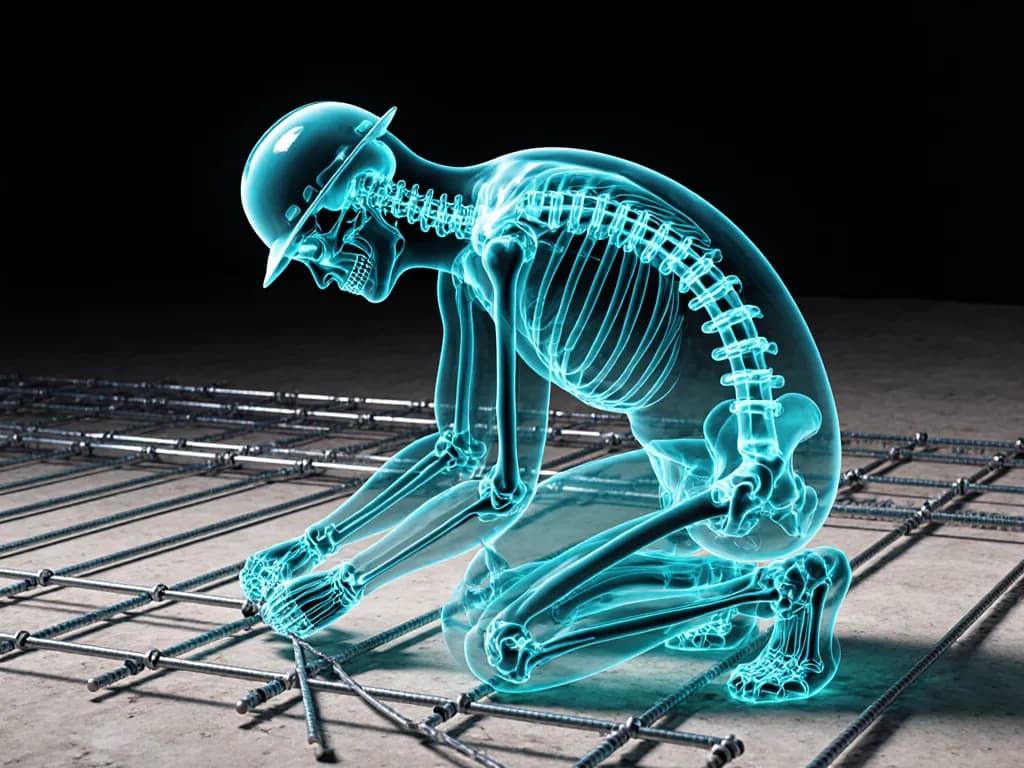
What is OWAS?
OWAS (Ovako Working Posture Analysis System) was developed in the Finnish steel industry by Karhu, Kansi, and Kuorinka in 1977 as a practical tool for systematic postural analysis. Unlike REBA or RULA which assess individual postures, OWAS assesses posture distribution across a full work cycle by coding observations at regular intervals — powerful for jobs with highly varied postures.
When to use OWAS
Use OWAS when the job involves a wide variety of postures over the shift — not a single sustained posture. It is the preferred method for whole-body time-sampling where you need to understand what proportion of the shift is spent in each posture, without stopping operations.
Primary citation: Karhu, O., Kansi, P., & Kuorinka, I. (1977). Correcting working postures in industry: A practical method for analysis. Applied Ergonomics, 8(4), 199–201.
What OWAS assesses
The body segments and task variables evaluated in a OWAS assessment.
Four Body Segment Codes
- Back (1–4): Straight / Bent / Twisted / Bent and twisted
- Arms (1–3): Both below shoulder / One at shoulder / Both above shoulder
- Legs (1–7): Sitting / Standing / One leg / Kneeling / Walking / etc.
- Load (1–3): <10 kg / 10–20 kg / >20 kg
Scoring and action levels
Final score range: Action Category 1–4 per posture code
Developed by: Karhu, Kansi & Kuorinka, 1977
Key characteristics
What makes OWAS the right tool for its intended use case.
Time-sampling method — captures posture distribution, not just worst-case
Four simple body codes — fast to apply in field conditions
Reveals cumulative exposure across the full shift
Particularly suited to varied, dynamic work environments
Results show which posture categories demand priority intervention
How Ergocure.ai applies OWAS
Ergocure AI applies OWAS via frame-level time sampling across the captured video clip. At each sampled frame, back, arm, and leg positions are coded automatically from body-landmark geometry. The distribution of time in each OWAS posture category is calculated across all frames, and the Action Category is determined per code before ergonomist review.

Captured on any phone, scored for OWAS, and validated by a certified ergonomist — face-blurred on-device.
OWAS and your ISO 45001 audit
ISO 45001 Clause 6.1.2 requires you to assess ergonomic risk — and triggers the technical ISO standard this method runs. Your auditor names the standard; Ergocure runs the assessment and a qualified ergonomist signs it off.
How we assess it
OWAS classifies whole-body working postures — back, arms and legs — together with the load handled, mapping each combination to an action category in line with the static-posture limits of ISO 11226. Ergocure derives the posture combination from an on-device capture or a structured survey, returns the OWAS action category, and a qualified ergonomist validates it — a repeatable, audit-defensible posture record for your ISO 45001 programme.
See all ISO standards & how we assess themOWAS — frequently asked questions
What is OWAS (Ovako Working Posture Analysis System)?
Analyse the distribution of working postures across an entire work cycle through time-sampling — identifying what proportion of time is spent in each posture category.
What is a good OWAS score?
Action Category 1–4 per posture code. A score of Category 1 is normal — no action required — while Category 4 is extremely harmful and means immediate intervention / work stop.
When should you use OWAS?
Use OWAS when the job involves a wide variety of postures over the shift — not a single sustained posture. It is the preferred method for whole-body time-sampling where you need to understand what proportion of the shift is spent in each posture, without stopping operations.
How does Ergocure score OWAS?
Ergocure AI applies OWAS via frame-level time sampling across the captured video clip. At each sampled frame, back, arm, and leg positions are coded automatically from body-landmark geometry. The distribution of time in each OWAS posture category is calculated across all frames, and the Action Category is determined per code before ergonomist review.
Who developed OWAS?
OWAS was developed by Karhu, Kansi & Kuorinka, 1977. Karhu, O., Kansi, P., & Kuorinka, I. (1977). Correcting working postures in industry: A practical method for analysis. Applied Ergonomics, 8(4), 199–201.
Related assessment methods
Methods commonly used alongside OWAS in a complete ergonomic assessment.
See OWAS in a live assessment
Request a Pilot — we'll run OWAS with your team and deliver validated reports in 48 hours.