


NIOSH — NIOSH Lifting Equation (Revised, 1994)
Calculate the Recommended Weight Limit (RWL) for two-handed manual lifting tasks and determine the Lifting Index (LI) — the ratio of actual load to the RWL.
What is NIOSH?
The Revised NIOSH Lifting Equation was published by the National Institute for Occupational Safety and Health in 1994 to provide a science-based tool for evaluating manual lifting demands. It combines biomechanical, metabolic, and psychophysical data to find safe lifting thresholds that protect roughly 90% of the working population from low-back injury. It applies six task multipliers to a baseline Load Constant of 23 kg (51 lb) to produce a Recommended Weight Limit for the specific lift.
When to use NIOSH
Use NIOSH for any two-handed manual lifting or lowering task that occurs in a predictable, non-slippery plane — warehouse picking, loading/unloading, palletising, and any manual material handling where the load weight and lifting geometry are measurable.
Primary citation: Waters, T.R., Putz-Anderson, V., Garg, A., & Fine, L.J. (1993). Revised NIOSH equation for the design and evaluation of manual lifting tasks. Ergonomics, 36(7), 749–776.
What NIOSH assesses
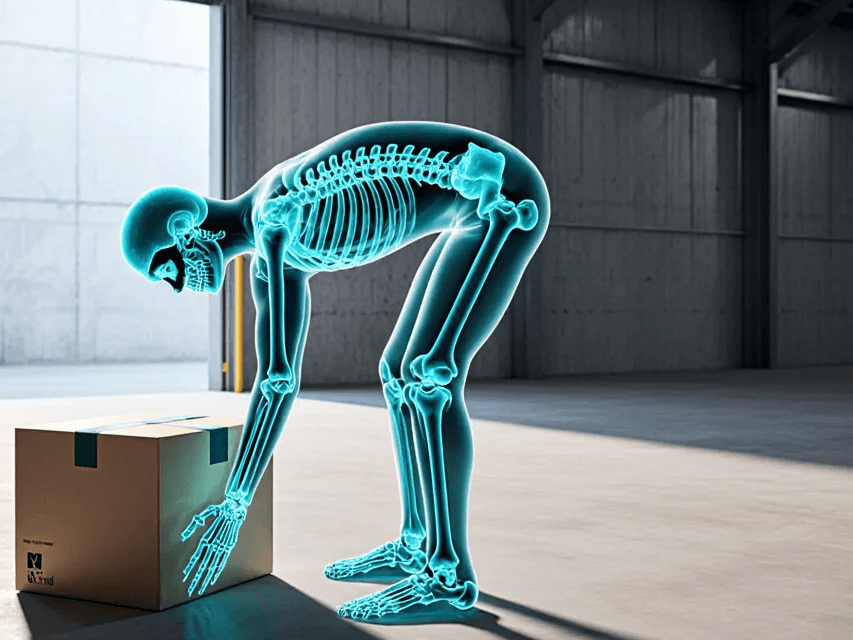
The body segments and task variables evaluated in a NIOSH assessment.
The measured load + six task multipliers
- Object weight — the actual load lifted (numerator of the Lifting Index)
- Horizontal multiplier (H) — distance of the load from the spine
- Vertical multiplier (V) — hand height at the lift origin
- Distance multiplier (D) — vertical travel of the lift
- Asymmetry multiplier (A) — twist angle from the sagittal plane
- Frequency multiplier (F) — lifts per minute over the task duration
- Coupling multiplier (C) — handhold quality: Good / Fair / Poor
Scoring and action levels
Final score range: Lifting Index (LI = Load ÷ RWL); RWL baseline 23 kg
Developed by: Waters et al., NIOSH, 1994
Key characteristics
What makes NIOSH the right tool for its intended use case.
Calculates Recommended Weight Limit for specific lifting tasks
Lifting Index directly quantifies how far a task exceeds safe limits
Six task multipliers account for real-world lifting geometry
Validated against epidemiological data across many industries
Foundation of OSH Code 2020 manual-handling risk criteria
How Ergocure.ai applies NIOSH
Ergocure AI applies NIOSH to manual lifting tasks captured via side and front views. AI Vision measures vertical hand height at origin and destination, estimates horizontal distance from the spine, and detects asymmetry angle from the sagittal plane. Frequency and coupling quality are entered via structured input. The six NIOSH multipliers are computed and the Lifting Index calculated before ergonomist review.

Captured on any phone, scored for NIOSH, and validated by a certified ergonomist — face-blurred on-device.
NIOSH and your ISO 45001 audit
ISO 45001 Clause 6.1.2 requires you to assess ergonomic risk — and triggers the technical ISO standard this method runs. Your auditor names the standard; Ergocure runs the assessment and a qualified ergonomist signs it off.
How we assess it
The NIOSH lifting equation implements ISO 11228-1 for two-handed manual lifting — the Recommended Weight Limit and Lifting Index computed from load, horizontal and vertical distance, lift height, asymmetry, frequency and coupling. Ergocure extracts the lift geometry from an on-device capture plus a few load details (or a camera-free survey), applies the ISO 11228-1 multipliers against the reference mass, flags out-of-range lifts, and a qualified ergonomist signs off the Lifting Index for your audit file.
See all ISO standards & how we assess themNIOSH — frequently asked questions
What is NIOSH (NIOSH Lifting Equation (Revised, 1994))?
Calculate the Recommended Weight Limit (RWL) for two-handed manual lifting tasks and determine the Lifting Index (LI) — the ratio of actual load to the RWL.
What is a good NIOSH score?
Lifting Index (LI = Load ÷ RWL); RWL baseline 23 kg. A score of LI ≤ 1.0 is acceptable — within rwl for the vast majority of workers — while LI > 3.0 is extreme and means high injury likelihood — engineering redesign.
When should you use NIOSH?
Use NIOSH for any two-handed manual lifting or lowering task that occurs in a predictable, non-slippery plane — warehouse picking, loading/unloading, palletising, and any manual material handling where the load weight and lifting geometry are measurable.
How does Ergocure score NIOSH?
Ergocure AI applies NIOSH to manual lifting tasks captured via side and front views. AI Vision measures vertical hand height at origin and destination, estimates horizontal distance from the spine, and detects asymmetry angle from the sagittal plane. Frequency and coupling quality are entered via structured input. The six NIOSH multipliers are computed and the Lifting Index calculated before ergonomist review.
Who developed NIOSH?
NIOSH was developed by Waters et al., NIOSH, 1994. Waters, T.R., Putz-Anderson, V., Garg, A., & Fine, L.J. (1993). Revised NIOSH equation for the design and evaluation of manual lifting tasks. Ergonomics, 36(7), 749–776.
Related assessment methods
Methods commonly used alongside NIOSH in a complete ergonomic assessment.
See NIOSH in a live assessment
Request a Pilot — we'll run NIOSH with your team and deliver validated reports in 48 hours.