

EAWS — Ergonomic Assessment Worksheet
A comprehensive whole-body screening worksheet that evaluates working postures, action forces, manual material handling, and repetitive upper-limb load in a single instrument.
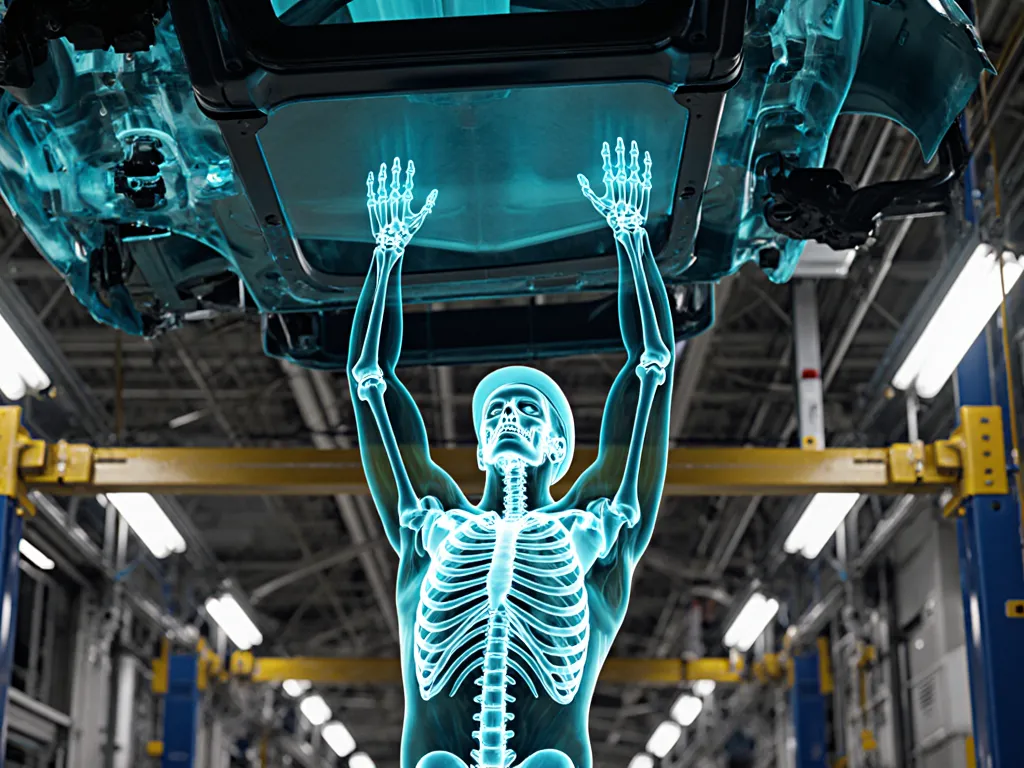
What is EAWS?
EAWS (also known as the European Assembly Worksheet) is a first-level screening tool widely used in automotive and assembly industries. It combines four whole-body sections — basic posture, action forces, and manual material handling — into a whole-body score, and scores repetitive upper-limb load separately, then reports the higher of the two on a traffic-light scale.
When to use EAWS
Use EAWS as a structured first-level screen for assembly and manufacturing workstations where posture, force, and manual handling all contribute to risk and you need one combined whole-body picture.
Primary citation: Schaub, K., Caragnano, G., Britzke, B., & Bruder, R. (2013). The European Assembly Worksheet. Theoretical Issues in Ergonomics Science, 14(6), 616–639.
What EAWS assesses
The body segments and task variables evaluated in a EAWS assessment.
What it assesses
- Section 0 — extra points (e.g. body postures during force exertion)
- Section 1 — working postures and movements held over time
- Section 2 — action forces of the whole body
- Section 3 — manual material handling
- Section 4 — repetitive load of the upper limbs (scored separately)
Scoring and action levels
Final score range: Points → traffic-light (whole-body vs upper-limb, higher governs)
Developed by: Schaub, Caragnano, Britzke & Bruder, 2013
EAWS is coming to Ergocure.ai
EAWS is part of our validated method roadmap. Our engine adds new methods on shared infrastructure — when EAWSgoes live it will run from the same on-device capture and certified-ergonomist review as our live methods. In the meantime, tell us your environment and we'll map the live methods that fit today.
EAWS — frequently asked questions
What is EAWS (Ergonomic Assessment Worksheet)?
A comprehensive whole-body screening worksheet that evaluates working postures, action forces, manual material handling, and repetitive upper-limb load in a single instrument.
What is a good EAWS score?
Points → traffic-light (whole-body vs upper-limb, higher governs). A score of 0–25 (green) is low — low risk — no action — while > 50 (red) is high and means high risk — redesign.
When should you use EAWS?
Use EAWS as a structured first-level screen for assembly and manufacturing workstations where posture, force, and manual handling all contribute to risk and you need one combined whole-body picture.
How does Ergocure score EAWS?
EAWS is on the Ergocure roadmap. Today the same workflow runs on our live methods — AI scores posture from a phone capture and a certified ergonomist validates every result.
Who developed EAWS?
EAWS was developed by Schaub, Caragnano, Britzke & Bruder, 2013. Schaub, K., Caragnano, G., Britzke, B., & Bruder, R. (2013). The European Assembly Worksheet. Theoretical Issues in Ergonomics Science, 14(6), 616–639.
Related assessment methods
Methods commonly used alongside EAWS in a complete ergonomic assessment.
Be first to know when EAWS lands
EAWS is on our roadmap. Request a Pilot of our live methods today, and we'll flag EAWS the moment it goes live.