


Modified LEST — Workplace-conditions evaluation (5-dimension histogram)
A whole-job workplace-conditions evaluation that scores five orthogonal dimensions on a common 0–10 scale and plots them as a histogram — so a physically light but psychologically punishing job, and its reverse, are both visible.
What is Modified LEST?
L.E.S.T. (Laboratoire d'Économie et de Sociologie du Travail; Guélaud et al., 1975) is one of the most complete frameworks for evaluating working conditions: it scores a job across five dimensions on a single 0–10 scale and plots them as a profile rather than collapsing them into one misleading number. Modified LEST is Ergocure's reconstruction for a tech-enabled clinical platform — it keeps LEST's five-dimension histogram and action-threshold philosophy, but scores the physical dimensions with validated modern instruments (RULA, REBA, OWAS, NIOSH — computer-vision-assisted, ergonomist-confirmed), the worker-experience dimensions with NASA-TLX, Karasek and the Karolinska Sleepiness Scale, and the environment with instrument-measured lux / dBA / °C mapped onto LEST's own native cotation tables. It runs as a mode of the ergonomist-led Site Assessment.
When to use Modified LEST
Use Modified LEST when a workplace needs a complete, defensible picture — physical load, environment, mental load, psychosocial strain and work time together — not a single posture score. It is administered by a certified ergonomist as part of a Site Assessment.
Primary citation: Guélaud, F., Beauchesne, M.N., Gautrat, J., & Roustang, G. (1975). Pour une analyse des conditions du travail ouvrier dans l'entreprise (LEST). CNRS, Aix-en-Provence.
What Modified LEST assesses
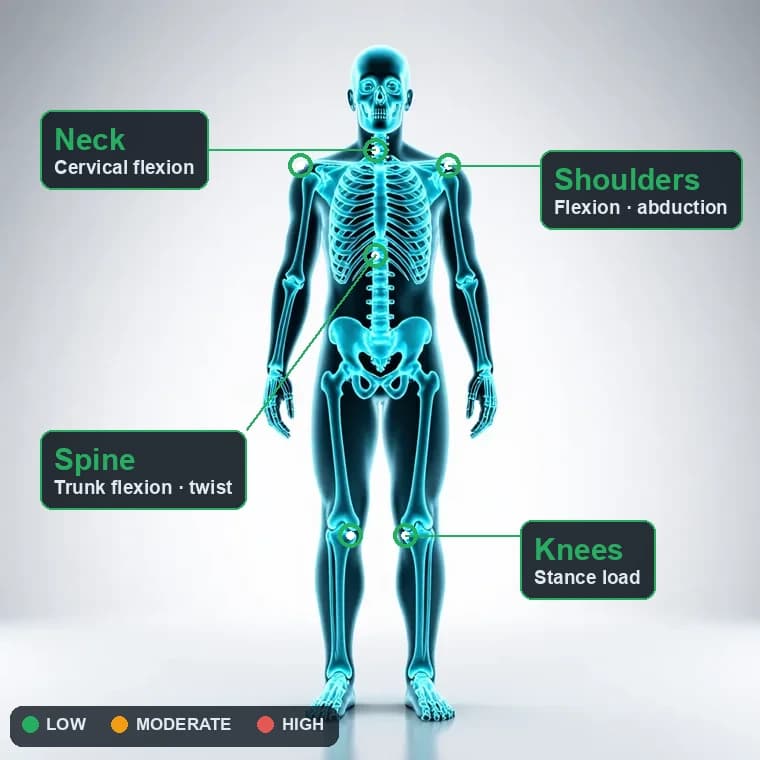
The body segments and task variables evaluated in a Modified LEST assessment.
Five dimensions — scored 0–10, never summed
- Physical load — RULA / REBA / OWAS / NIOSH, computer-vision-assisted and ergonomist-confirmed
- Physical environment — instrument-measured lux / dBA / °C mapped to LEST's native Guélaud cotation
- Mental load — NASA-TLX (perceived task demand)
- Psychosocial factors — Karasek demand–control
- Work time — Karolinska Sleepiness Scale + shift pattern
Scoring and action levels
Final score range: 0–10 per dimension · plotted as a 5-axis histogram (never summed)
Developed by: Guélaud, Beauchesne, Gautrat & Roustang, 1975 (CNRS) · Modified by Ergocure
How Ergocure.ai applies Modified LEST
Modified LEST runs inside the ergonomist-led Site Assessment. The physical dimensions are scored from on-site captures (RULA / REBA / OWAS / NIOSH, computer-vision-assisted), the environment from instrument readings (lux / dBA / °C) mapped onto LEST's native cotation tables, and the worker-experience dimensions from an ergonomist-administered interview (NASA-TLX, Karasek, Karolinska Sleepiness Scale). A completeness gate blocks the report until all five dimensions have data, and the result is plotted as a five-axis histogram.

Captured on any phone, scored for Modified LEST, and validated by a certified ergonomist — face-blurred on-device.
Modified LEST — frequently asked questions
What is Modified LEST (Workplace-conditions evaluation (5-dimension histogram))?
A whole-job workplace-conditions evaluation that scores five orthogonal dimensions on a common 0–10 scale and plots them as a histogram — so a physically light but psychologically punishing job, and its reverse, are both visible.
What is a good Modified LEST score?
0–10 per dimension · plotted as a 5-axis histogram (never summed). A score of 0–2 is satisfactory — optimal working conditions — while 10 is exceeds limit and means exceeds the exposure limit — act now.
When should you use Modified LEST?
Use Modified LEST when a workplace needs a complete, defensible picture — physical load, environment, mental load, psychosocial strain and work time together — not a single posture score. It is administered by a certified ergonomist as part of a Site Assessment.
How does Ergocure score Modified LEST?
Modified LEST runs inside the ergonomist-led Site Assessment. The physical dimensions are scored from on-site captures (RULA / REBA / OWAS / NIOSH, computer-vision-assisted), the environment from instrument readings (lux / dBA / °C) mapped onto LEST's native cotation tables, and the worker-experience dimensions from an ergonomist-administered interview (NASA-TLX, Karasek, Karolinska Sleepiness Scale). A completeness gate blocks the report until all five dimensions have data, and the result is plotted as a five-axis histogram.
Who developed Modified LEST?
Modified LEST was developed by Guélaud, Beauchesne, Gautrat & Roustang, 1975 (CNRS) · Modified by Ergocure. Guélaud, F., Beauchesne, M.N., Gautrat, J., & Roustang, G. (1975). Pour une analyse des conditions du travail ouvrier dans l'entreprise (LEST). CNRS, Aix-en-Provence.
Related assessment methods
Methods commonly used alongside Modified LEST in a complete ergonomic assessment.
See Modified LEST in a live assessment
Request a Pilot — we'll run Modified LEST with your team and deliver validated reports in 48 hours.